
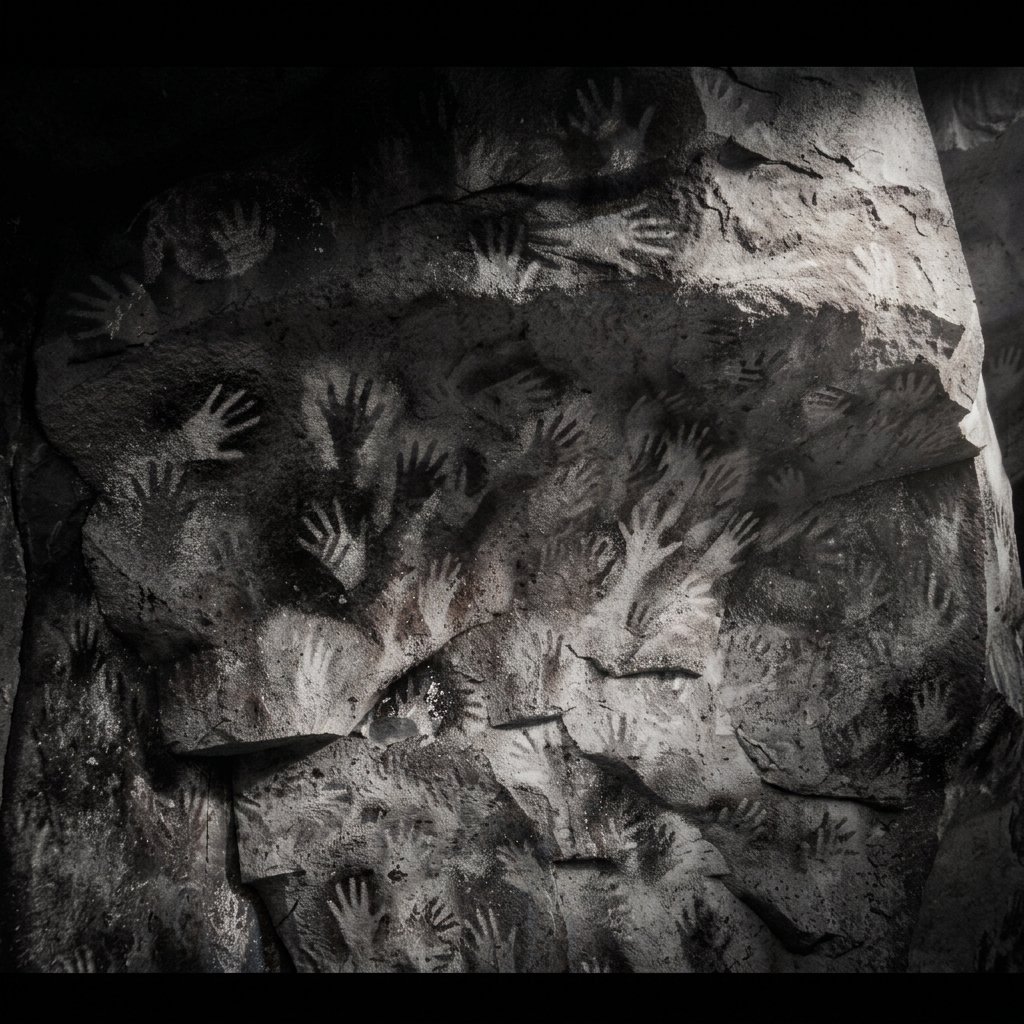
The great majority of animals (fish, amphibians, reptiles, birds, and mammals) have the left side of their brains commanding the right side of their bodies and the right side of their brains commanding the left side of their bodies (lateralization), in an asymmetrical way (brains are different on the right and left sides).
According to the fossil record, little scratches on several teeth dating between 600,000 and 400,000 years ago indicated that a group of human ancestors was using their teeth as support to perform different tasks (like ripping apart other animals’ skin), and the pattern indicates that they were using predominantly one of their hands (majority the right hand) to execute those tasks.
Using consistently one side of the body to perform different tasks makes asymmetry and lateralization of the brain more “intense and extreme,” which is a specific characteristic found in just one animal species (not even other primates) on Earth’s surface – humans.
Spotting handedness in the human skeleton is easy, with one arm visibly more developed than the other. However, finding fossils with both arms belonging to the same individual is extremely rare; therefore, the patterns left on the small marks in fossilized teeth are fundamental in identifying this transition to humans.
Despite the same pattern of scratches on fossilized teeth having also been spotted on one individual 1,800,000-year-old fossil, it is the evidence of a whole group having handedness that makes this find dating between 600,000 and 400,000 years ago a compelling milestone for humans.
In living humans today, handedness is present in 99% of the population, and it manifests as a spectrum within individuals, with left-handed people always being a minority (around 10%) within populations worldwide.
Counterintuitively, there is not a single gene responsible for handedness in humans, with recent studies showing that at least forty parts of the human genome contribute to the trait with a complex inheritance pattern.
Handedness in humans is about choosing one side of the body to perform tasks more consistently, with several studies showing that cognitively, there are no differences between right- and left-handers.
To illustrate, despite handedness being correlated with the cognitive process of language (associated with brain lateralization, where the majority of humans carry out language functions in the left hemisphere of their brains), only a minority of individuals have the right hemisphere of their brains carrying out language functions, and surprisingly, they are equally right- and left-handed.
Skills associated with enhanced lateralization and brain asymmetry in humans—such as innovation, tool making, process thinking, rich collaboration, and culture—are present in various animals when analyzed in isolation. Yet, only humans excel across all these domains simultaneously. Handedness is not just about preference in our hands; it is the physical proof of an extremely specialized brain capable of running these complex cognitive operations at once.
Ultimately, what sets humanity apart isn’t a lofty philosophical concept, but a humble biological habit recorded in ancient teeth.
Whether right- or left-handed, this extreme brain lateralization is the silent engine behind every technology, every art form, and every shared culture.
It even offers a fresh mirror for modern divides – reminding us that “right” and “left” in human nature are not simply symmetrical opposites; it is far more complex than just two identical sides of the same coin.
All references for this article can be found here.